You learn the Amiodarone dose in class on Monday. By Thursday's shift you hesitate. 150mg or 300mg? Rapid IVP or slow drip? You highlighted it. It is still gone, or too fuzzy to trust with a patient in front of you. That is not a lack of effort. It is how memory works, and there is a proven fix.
The Forgetting Curve
In the 1880s Hermann Ebbinghaus showed, in findings replicated many times since, that without review we forget roughly 70% of new information within 48 hours. Most CE runs annually or semi-annually, so by the next class you are relearning from scratch.
How Spaced Repetition Works
You review material just before you would forget it. Get it right and the next review moves out: a day, three days, a week, two weeks, a month. Miss it and it comes back soon. Your time goes to what you are weakest on. Studies of medical students learning pharmacology found retention two to three times higher with spaced review than with cramming for the same total time.
SM-2, developed by Piotr Wozniak in the late 1980s, is the most widely used algorithm for this. You rate how easily you recalled each answer; easy items get longer intervals, hard ones return quickly, and the schedule adapts to you. Two medics studying the same protocol get different schedules. Instead of 30 minutes on 50 drugs you mostly know, you spend 10 minutes on the 12 you do not.
Why It Fits EMS
Protocol knowledge is discrete and factual, which is exactly what spaced repetition handles best:
- Dosing: adult and pediatric doses, concentrations, max doses, drip rates.
- Contraindications: often harder to hold onto than the dose.
- Algorithms: so you do not have to think through each branch on scene.
- Your protocol's specifics: not the national or neighboring agency's version.
Amiodarone: Cramming vs. Spacing
Cramming: you read the section three times the night before a skills check and remember it the next morning. Two weeks later you cannot recall whether the maintenance infusion is 1mg/min or 150mg over 10 minutes, and you pull up the PDF.
Spaced: you get the initial dose right on day one, again on day three, again on day eight. By day twenty it is effortless and the next review moves out six weeks. Meanwhile the system drills Adenosine's rapid push daily, because you keep mixing it up with Amiodarone's slow infusion. Same study time, very different retention at 30 and 90 days.
Where Traditional CE Falls Short
Infrequent long sessions, passive lectures, the same content for a 20-year veteran and a new medic, and no follow-up until the next class. Spaced repetition does not replace CE. It fills the gap between classes.
Spaced Repetition in ProtoQuiz
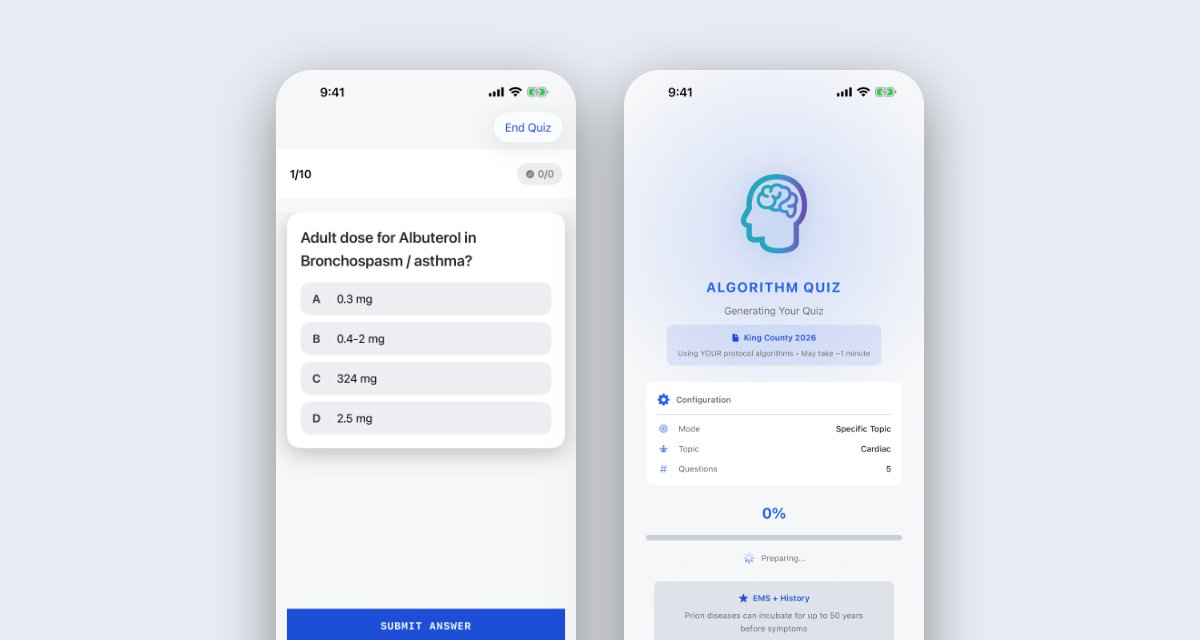
Adaptive SM-2 spaced repetition built into Learn Mode, applied to your agency's medications and protocol facts.
Protocol-specific cards generated automatically from your uploaded PDF — no manual flashcard-making.
Every answer cites the exact page in your protocol PDF — verify in seconds.
Getting Started
Paper works: the Leitner system sorts flashcards into boxes, with misses going back to the daily box. For EMS, generating cards from your protocols saves hours. ProtoQuiz's Learn Mode runs SM-2 on your agency's medications and builds the deck from your uploaded PDF, with page citations.
- Short and frequent beats long and rare. Ten minutes daily beats an hour once a week.
- Trust the schedule. Review what it tells you to review.
- Rate honestly. A hesitation or lucky guess is a hard item.
- Give it two weeks. The difference shows up in week two or three.
For an agency or training program, spaced repetition gives a measurable way to find and close each provider's gaps without re-teaching what they already know.
Your protocols do not change between shifts. Your memory of them does. Spaced repetition closes that gap.
Keep reading: Get the ProtoQuiz app · How to study EMS protocols · EMS pharmacology study guide
